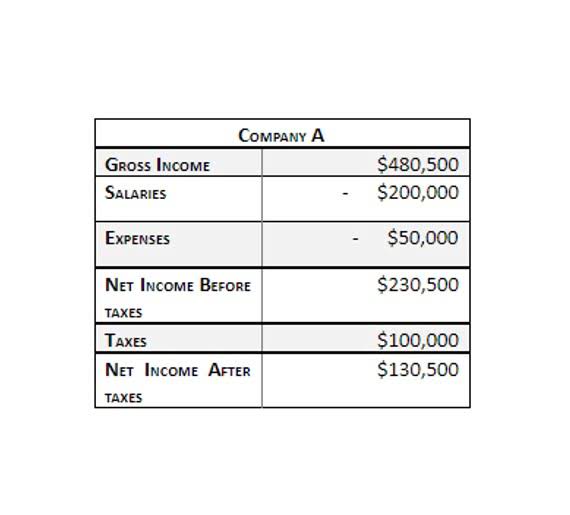
This category includes income or expenses that are not directly related to the core operations of the business. It typically includes items such as interest income, interest expense, gains or losses from the sale of assets, and other non-operating activities. These analyses help stakeholders gauge the company’s ability to generate income and manage its financial health in the face of market and economic changes. The key difference between IFRS and GAAP in the context of comprehensive income lies in the specific requirements and classifications of income and expense items. While comprehensive income provides valuable insights into all changes in equity, it’s essential to consider the tax implications of the items reported in OCI.

Create a Trial Balance Report

However, several items included in it may affect what a business owes later on. For example, gains or losses from available-for-sale securities or cash flow hedges might influence taxes, depending on whether they become realized and when that happens. Local tax rules often determine how and when these items are reported. A company might see changes in the value of its assets during the year, but those changes won’t immediately affect its tax return.
The Evolution of Income Reporting
These developments have significant implications for how companies prepare and present their financial statements. When preparing the Statement of Comprehensive Income, it is essential for companies to follow the relevant accounting standards, whether IFRS or GAAP. These standards ensure the consistency, comparability, and reliability of the financial statements, allowing stakeholders to accurately assess the financial health and performance of the company. To illustrate, consider a company that operates in multiple countries. It may have investments in foreign markets that are subject to currency fluctuations.
Earnings per Share
The statement of comprehensive income enables businesses to communicate a broader picture of their financial performance to investors and other stakeholders. It provides insights into the various components affecting the company’s profitability and financial position. It demonstrates the company’s commitment to transparent reporting. The statement of comprehensive income provides a more comprehensive and transparent view of a company’s financial performance. It allows stakeholders to understand the impact of non-operational factors on the company’s overall financial position.
A smaller company with basic operations may not have been involved in any of the activities that show on a statement of comprehensive income. If this is the case, statement of comprehensive income they are not required to produce the statement. The term basic earnings per share refers to IFRS companies with a simple capital structure consisting of common shares and perhaps non-convertible preferred shares or non-convertible bonds. The multiple-step income statement format provides much more detail. Below is an example of a multiple-step statement of income for Toulon Ltd., an IFRS company, for the year ended December 31, 2020.
Interpreting the statement of comprehensive income
However, within these frameworks, companies have discretion over how they classify and display components of comprehensive income. This leads to a rich tapestry of presentation styles, each tailored to convey the unique financial narrative of the reporting entity. The net gets moved into a company’s statement of comprehensive income where adjustments are made for non-owner activities. This statement has several benefits that stakeholders can take advantage of, but it also has a few limitations that might restrict how truly useful it can be. By adding bookkeeping other comprehensive with your net from your normal income statement, you will get your company’s comprehensive income.

Data Safety

These items are excluded from net profit or loss primarily because they are considered irregular or non-recurring or because of specific accounting rules that exclude them from the income statement. Other comprehensive income (OCI) is an important component of comprehensive income, but they are https://mfkhaddar.com/a-complete-guide-to-choosing-the-right-accounts/mfkhaddar.com/unstitched/ck01670-uns-c02/ not interchangeable. OCI, sometimes referred to as comprehensive earnings, represents specific types of unrealized gains and losses that are not included in a company’s net income.
- This helps make sure financial statements are both complete and correct.
- In summary, for accounting purposes, assets may be considered as held for sale when there is a formal plan to dispose of the segment.
- These items might not show up in a regular income statement but still affect the company’s value.
- This statement captures all changes in a company’s equity during a particular period that are not due to transactions with shareholders.
- Accurate calculation of comprehensive income requires attention to detail and a thorough understanding of accounting principles.
- OCI items occur more frequently in larger corporations that encounter such financial events.
- A company can have a balance of either other comprehensive income or loss, depending on if the value of the investments increases or decreases.
It’s vital to note how unrealized gains might affect future finances. This awareness helps a company stay flexible and strong during market changes. Balancing current results with future possibilities is important for growth.
What Are Operating Expenses? Small Business Guide
- This number is then transferred to the balance sheet as accumulated other comprehensive income.
- Smaller privately held companies tend to use the simpler single-step format, while publicly traded companies tend to use the multiple-step format.
- It is great for looking into revenue handling, expense managing, and tax efficiency.
- Understanding a company’s financial performance is crucial in finance, investment, and strategic planning.
- It includes all changes in equity during a period except those resulting from investments by owners and distributions to owners.
- This ensures a company runs smoothly and makes smart financial decisions.
This view tells us if the business made a profit in a certain period. Both equity and fixed-income analysts use it to check financial health and predict earnings. The multiple-step format with its section subtotals makes performance analysis and ratio calculations such as gross profit margins easier to complete and makes it easier to assess the company’s future earnings potential. For instance, a company might report a change in foreign currency of $64,721. Also, a net unrealized gain on derivatives of $5,793 can be reported.
B. Impact on Shareholders’ Equity
By examining sections like Gross Profit and Cash Flow, stakeholders can spot growth opportunities. Understanding the details in these documents is crucial for making smart future decisions. Keeping up with the International Financial Reporting Standards (IFRS) is a big hurdle. Not following it closely might mess up how financial statements are understood or compared. Making mistakes when preparing an income statement can mess up a company’s financial picture. It’s important to note that comprehensive income can be negative if OCI losses exceed net income or if there’s a net loss for the period.